Intent by Keyword: SEO Guide and Strategy Overview
Breadcrumb
What does intent by keyword mean in modern SEO?
Intent by keyword is the practice of classifying search terms by the goal behind the query. Instead of looking only at volume, difficulty, or trend lines, you ask what the searcher is actually trying to do. That shift makes keyword research far more useful because it helps you match the right page, message, and offer to the right stage of the journey.
For SEO managers and marketing decision-makers, intent creates structure. It helps you decide whether a query belongs on a service page, a buying guide, a comparison page, or an educational article. For a digital marketing agency, it improves client prioritization and reporting. For a small business owner, it prevents wasted effort on traffic that looks promising but has little chance of converting. For a content marketing manager, it connects editorial planning to measurable business outcomes.
The basic idea is simple: not every keyword deserves the same treatment. Some searches signal immediate buying interest. Others show curiosity, research behaviour, or the need for reassurance before a decision. Once you start grouping keywords by likely user goal, your SEO workflow becomes more focused and your content becomes easier to prioritize.
A useful intent framework helps you:
- Match pages to searcher goals
- Improve content targeting and internal alignment
- Separate traffic potential from conversion potential
- Reduce overlap between pages targeting different needs
- Build more realistic SEO forecasts
Intent is what turns keyword research from a long list into a practical strategy.
How do commercial, informational, and navigational keywords differ?
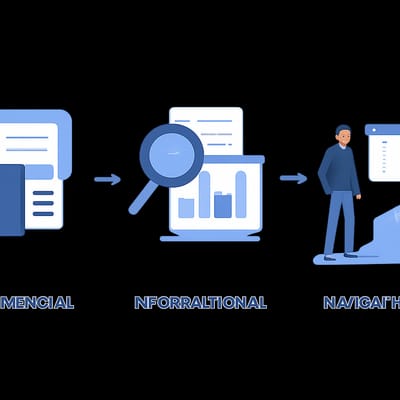
Most keyword strategies rely on three core intent categories: commercial, informational, and navigational. These labels are simple, but they have major implications for page type, tone, metrics, and expected outcomes.
Commercial intent
These searches suggest evaluation or buying behaviour. Users may be comparing options, looking at pricing, or searching for providers. These keywords often belong on service pages, category pages, comparison content, and decision-stage resources.
Informational intent
These searches signal a learning goal. The user wants to understand a topic, solve a problem, or explore possibilities. Informational keywords often work best for guides, FAQs, tutorials, and supporting content that builds trust.
Navigational intent
These searches indicate that the user already has a destination in mind. They may be looking for a specific company, platform, or page. Navigational terms can matter, but they rarely behave like broad discovery keywords.
The challenge is that real searches often blend signals. A keyword may look informational on paper but still sit very close to purchase behaviour. That is why SERP review matters. Look at the pages already ranking, the language used in results, and the content formats that dominate.
For UK-focused teams, local phrasing can also change how intent should be interpreted. Small shifts in wording may signal a stronger commercial angle, especially in service-led markets. Understanding that nuance helps teams avoid building the wrong page for the wrong search.
Why does keyword intent matter for tools, content, and ROI?

Intent matters because it shapes every major SEO decision after research begins. If you misread intent, you may choose the wrong page type, create the wrong content, or report on the wrong metrics. That leads to lower conversion rates, weaker rankings, and poor use of budget.
Intent improves tool evaluation
Not every keyword platform supports intent analysis equally well. Some are better for broad topic discovery. Others are stronger for evaluating buying-stage terms, CPC signals, and competitive gaps. If your team needs to choose between a service provider and a tool subscription, intent analysis should be part of that comparison.
Intent improves content planning
A content marketing manager can use intent to group keywords into clusters, briefs, and refresh priorities. Informational themes often support awareness and trust, while commercial themes help capture demand closer to the point of action.
Intent improves ROI discussions
Small business owners and marketing leaders often need to justify spend clearly. Intent helps because it connects keyword targeting to likely business value, not just traffic estimates. A keyword with modest volume can outperform a high-volume term if it attracts users closer to conversion.
Digital marketing agencies also benefit because intent-based reporting makes recommendations easier to defend in client conversations. Instead of saying a keyword is “good,” you can explain where it sits in the funnel and why it deserves investment.
This is also why topics such as provider comparisons, agency hiring questions, ROI case studies, and CPC interpretation matter. They all become easier to assess once the team agrees on what each keyword is really trying to accomplish.
How should you apply an intent by keyword framework in practice?
A practical intent by keyword workflow should be clear enough to repeat and flexible enough to adapt as results come in. The goal is to move from raw query lists to pages and priorities that support traffic, leads, and revenue.
A simple workflow for applying intent
- Collect keyword themes from your core products, services, and audience questions.
- Review SERPs to identify what users appear to want.
- Label keywords by likely intent and funnel stage.
- Match each keyword group to a suitable page type.
- Prioritize based on business value, competition, and available resources.
- Track performance and refine intent assumptions over time.
This process helps different teams in different ways. An SEO manager may use it to align stakeholders around opportunity size and expected outcomes. A content marketing manager may use it to shape briefs and publishing calendars. A digital marketing agency may use it to standardize client audits and ongoing reporting. A small business owner may use a leaner version of the same framework to focus on the pages most likely to generate enquiries.
The strongest workflows also include CPC awareness, competitor review, and post-publication analysis. Those elements help you decide whether a keyword is simply interesting or commercially meaningful. Over time, the framework becomes less about labeling keywords and more about improving the quality of decisions your team makes every week.
What should you look for when evaluating tools and providers?
Once intent is clear, the next question is whether your current setup can support it. Some teams need a self-serve platform with strong filtering and reporting. Others need expert analysis, prioritization, and strategic guidance. Many need a combination of both.
Evaluate tools and providers against these criteria
- Intent visibility: Can the solution make commercial and informational opportunities easy to separate?
- Workflow fit: Does it fit how your team plans, writes, approves, and reports?
- UK relevance: Can it reflect local search behaviour, language, and competition?
- Pricing clarity: Is cost transparent enough to support ROI planning?
- Actionability: Will outputs turn into briefs, landing pages, and campaign decisions?
A digital marketing agency may prioritize scalable processes and client reporting. A small business owner may care more about speed, simplicity, and direct recommendations. A content marketing manager often needs clear topic groupings and practical outputs that fit an editorial workflow.
This broader category also includes related subjects worth exploring more deeply, such as how to compare keyword research services, what to ask when hiring a search optimization company, how to assess ROI from keyword research investments, and how to interpret CPC in planning decisions. Those topics build on the same foundation: intent first, then tools, then execution.
The best choice is rarely the one with the longest feature list. It is the one that helps your team make better decisions with less friction.
How will intent by keyword shape future SEO workflows?
The future of intent by keyword is not just better labeling. It is better decision-making across research, content, and performance analysis. As search ecosystems evolve, teams will need more precise ways to understand not only what users search for, but what stage of consideration they are in and what type of result they expect.
Trends to watch
- Better intent modeling within keyword platforms
- Stronger links between keyword data and content workflows
- More useful forecasting for commercial outcomes
- Faster identification of content gaps and SERP shifts
- Clearer reporting for leadership and cross-functional teams
For UK organizations, this will likely increase the value of tools and services that can combine local nuance with commercial context. SEO managers will need systems that support prioritization, not just reporting. Agencies will benefit from workflows that scale without sacrificing interpretation. Small business owners will continue to favor solutions that reduce complexity. Content marketing managers will need research that fits directly into briefs, refresh cycles, and performance reviews.
Intent will also keep influencing adjacent decisions around hiring, budgeting, provider selection, and content investment. Topics like ROI case studies, evaluation checklists, and questions for agency selection will remain important because they help teams act on the data with more confidence.
In practice, the best future-proof strategy is simple: organize your keyword process around user goals, then choose tools and services that make those goals easier to identify and serve.
FAQ
What is intent by keyword in SEO?
Intent by keyword is the process of grouping search terms by the goal behind the search. It helps you understand whether a user wants information, wants to compare options, or is trying to reach a specific destination. That makes it easier to choose the right page type and content format.
Why is keyword intent important for SEO managers?
It improves prioritization, forecasting, and page targeting. SEO managers can use intent to align teams around business value instead of traffic alone. That usually leads to stronger decision-making and clearer reporting.
How can digital marketing agencies use an intent by keyword framework?
Agencies can use it to standardize audits, prioritize client recommendations, and explain strategy more clearly. It also helps separate awareness content from decision-stage opportunities. That makes reporting more useful and recommendations easier to defend.
What is the best way for a small business owner to use keyword intent?
Start small and focus on the pages most likely to generate enquiries or sales. A small business owner does not need a huge keyword universe to benefit from intent analysis. Even basic labeling can prevent wasted effort on low-value traffic.
How does keyword intent help content marketing managers?
It helps them create better briefs, build content clusters, and choose topics that support both visibility and conversion goals. Informational and commercial keywords can work together when they are mapped intentionally. That improves editorial planning and content performance.
Can one keyword have more than one type of intent?
Yes, and that is common. Some searches contain mixed signals, especially when users are still evaluating options. That is why reviewing the SERP is often just as important as reviewing keyword metrics.
How does intent affect keyword research tool selection?
It helps you judge whether a tool supports your actual goals. Some tools are stronger for topic discovery, while others are better for commercial analysis and prioritization. The best choice depends on your workflow and the kind of decisions you need to make.
How can I connect keyword intent to ROI?
Focus on how intent influences page quality, lead quality, and conversion potential. A lower-volume commercial term can deliver more value than a high-volume informational term. ROI becomes clearer when keywords are judged by business impact, not traffic alone.